

If you run a personal injury law firm, you already know that ranking on Google can make or break your practice.
This guide will walk you through everything you need to know about SEO for personal injury lawyers, from technical setup to content creation to link building strategies that actually work.
Understanding What It Takes to Compete In Personal Injury Lawyer SEO In Major Markets
Personal injury law is one of the most competitive practice areas in SEO, especially in major metropolitan areas like Los Angeles, New York, Miami, Chicago, and Houston.
If you’re practicing in a competitive market, you need to understand that ranking will require substantial time, effort, and often financial investment.
The Reality of Competition in Top Metro Areas
In cities like Los Angeles or New York, you’re competing against personal injury law firms that have been investing in SEO for years or even decades.
These firms have hundreds of pages of content, hundreds or thousands of backlinks from authoritative sites, and massive budgets for ongoing optimization and content creation.
Some of the top-ranking personal injury firms in these markets are spending $20,000 to $50,000 per month or more on their SEO efforts, including content creation, link building, and technical optimization.
You need to have realistic expectations about timelines. Personal injury lawyer SEO for competitive terms like “personal injury lawyer Los Angeles” could take 12 to 24 months of consistent effort, even with a solid strategy.
The good news is that you don’t need to rank #1 for the most competitive terms to get results, and there are plenty of less competitive but still valuable keywords you can target while building toward your larger goals.
Finding Your Competitive Edge
Rather than trying to out-compete established firms on generic terms right away, focus on carving out your own niche within personal injury law.
Maybe you specialize in a specific type of accident, serve a particular demographic, or focus on a geographic subset of your metro area that larger firms overlook.
You can also compete on service quality and case results rather than pure search rankings, building a reputation that generates referrals and repeat business even as you work on your SEO.
Look for keyword opportunities that have decent search volume but lower competition, such as long-tail variations like “truck accident lawyer in [neighborhood]” or “how much is my car accident case worth in [city]”.
These more specific terms often convert better anyway because they attract people who know exactly what they’re looking for and are further along in their decision-making process.
Setting the Foundation: Website Audit and Technical Preparation

Before you start chasing rankings, you need to make sure your website is actually ready to compete.
Too many law firms jump straight into content creation without fixing the fundamental problems that will prevent them from ranking no matter how much content they publish.
Conducting a Comprehensive Site Audit
Start by running a full technical audit of your website to identify any issues that could be holding you back.
Use tools like Semrush’s Site Audit feature or Screaming Frog to crawl your entire site and find problems like broken links, duplicate content and slow-loading pages.
Pay special attention to crawl errors, redirect chains and pages that return 404 errors since these waste your site’s crawl budget and create a poor user experience.
Your audit should also check for mobile usability issues since Google uses mobile-first indexing, meaning the mobile version of your site is what Google primarily looks at for ranking purposes.
If your site isn’t mobile-friendly, you’re already starting at a massive disadvantage before you even begin your SEO efforts.
Fixing Critical Technical Issues
Once you’ve identified problems, prioritize fixing them based on severity and impact.
Start with issues that directly prevent Google from crawling or indexing your pages, such as broken robots.txt files, incorrect noindex tags, or server errors that return 5xx status codes.
Next, tackle redirect issues by consolidating redirect chains into single redirects and fixing any redirect loops that could confuse search engines.
Clean up your internal linking structure to ensure every important page on your site can be reached within three clicks from your homepage.
Finally, address speed issues by compressing images, minifying CSS and JavaScript files, leveraging browser caching, and considering a content delivery network (CDN) if your site serves visitors across multiple geographic regions.
Ensuring Your Site Structure Supports SEO
Your website architecture plays a huge role in how well you can rank for competitive personal injury keywords.
Create clear silos for different practice areas, with dedicated sections for car accidents, slip and falls, medical malpractice, wrongful death, and any other areas you focus on.
Each practice area should have its own hub page that links out to more specific pages beneath it, creating a logical hierarchy that helps both users and search engines understand your site’s organization.
Use descriptive, keyword-rich URLs that clearly indicate what each page is about, avoiding generic URLs like “/page1” or “/services” in favor of URLs like “/car-accident-lawyer” or “/slip-and-fall-attorney”.
This structure not only helps with personal injury lawyer SEO but also makes it easier for potential clients to find exactly what they’re looking for on your site.
Essential SEO Tools You’ll Need

You can’t effectively do SEO for personal injury lawyers without the right tools to guide your strategy and measure your results.
While there are dozens of SEO tools available, a few are essential for personal injury law firms who want to compete effectively.
Tools for Competitive Intelligence and Tracking
Semrush is one of the most comprehensive SEO platforms available and should be your primary tool for keyword research, competitor analysis, and rank tracking.
Use it to identify which keywords your competitors are ranking for, how much traffic those keywords are generating, and what content is performing best for them.
The Position Tracking feature lets you monitor your rankings for target keywords over time, so you can see which of your SEO efforts are working and which need adjustment.
Semrush also provides valuable data on backlinks, showing you who’s linking to your competitors and helping you identify potential link opportunities for your own site.
Expect to pay around $130 to $250 per month for Semrush depending on the plan you choose, but it’s worth every penny if you’re serious about competing in personal injury SEO.
Content Optimization Tools
Content optimization tools like SurferSEO, Rankability or Clearscope analyze the top-ranking pages for any given keyword and tell you exactly what you need to include in your content to compete.
These tools look at factors like content length, keyword usage, related terms, headings structure, and other on-page elements that correlate with high rankings.
They provides a real-time content editor that scores your content as you write and suggests specific terms and phrases to include based on what’s working for top-ranking pages.
All of these tools will significantly improve your content’s chances of ranking by ensuring you’re not missing critical elements that search engines expect to see.
Additional Tools Worth Considering
Beyond Semrush and a content optimization tool, consider adding Google Search Console for monitoring your site’s performance in Google’s search results and identifying technical issues.
Ahrefs is an alternative to Semrush that some SEO professionals prefer, particularly for backlink analysis and finding link opportunities.
Google Analytics is essential for understanding how visitors interact with your site, which pages convert best, and where your traffic is coming from.
Finally, a tool like Screaming Frog SEO Spider is invaluable for conducting detailed technical audits and finding issues that might be holding your site back.
Keyword Research: Finding the Right Terms to Target

Keyword research for personal injury law firms is the foundation of any successful SEO strategy, requiring a specific approach that balances search volume, competition, and commercial intent.
Identifying High-Value Commercial Keywords
Start by brainstorming all the services you offer and the types of cases you handle, then use Semrush to find related keywords and their search volumes.
For personal injury lawyers, your core commercial keywords will typically include terms like “[type] accident lawyer,” “[type] injury attorney,” “personal injury lawyer [city],” and variations of these.
Look at the search volume, keyword difficulty score, and cost-per-click data to identify which terms are worth targeting based on their potential value and your ability to compete.

High CPC values often indicate keywords with strong commercial intent, meaning people searching these terms are more likely to hire a lawyer than those searching informational queries.
Create a spreadsheet of your target keywords organized by category, priority, and current ranking position so you can track your progress over time.
Finding Long-Tail Keyword Opportunities
Long-tail keywords are longer, more specific search phrases that typically have lower search volume but also lower competition and higher conversion rates.
Examples might include “can I sue if I was partially at fault in a car accident,” “how long do I have to file a slip and fall lawsuit in [state],” or “average settlement for rear-end collision with herniated disc”.
These keywords often align with specific questions your potential clients are asking and can be easier to rank for while you build authority for more competitive head terms.
Use the “Questions” feature in Semrush or look at the “People Also Ask” boxes in Google search results to find these long-tail opportunities.
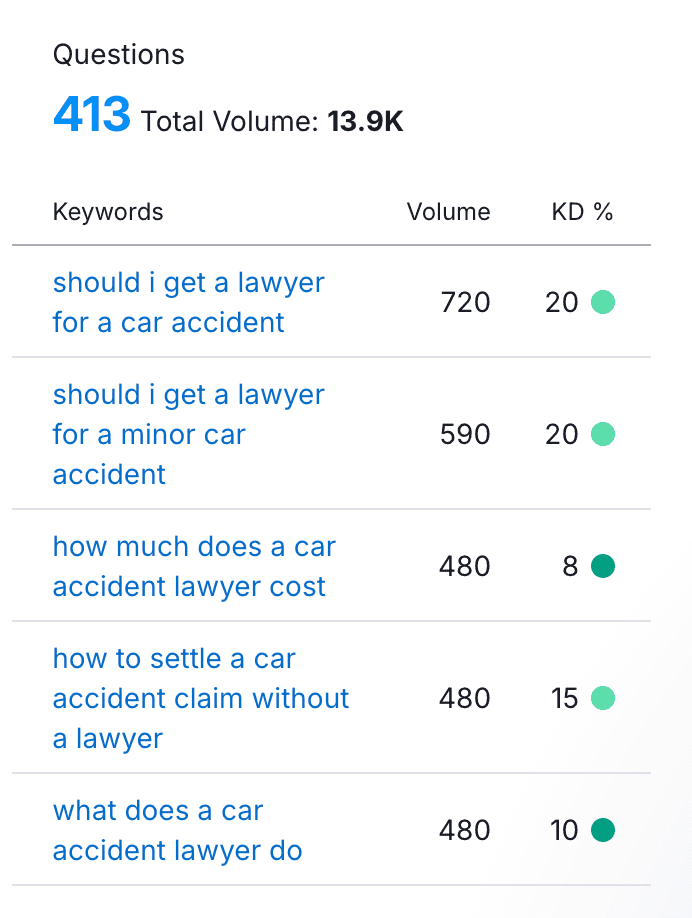
You can also mine forums, Reddit, Quora, and legal advice sites to find the actual questions people are asking about personal injury cases.
Understanding Search Intent
Not all keywords are created equal, and understanding search intent is crucial for targeting the right terms and creating content that actually ranks.
Keywords can have informational intent (someone looking to learn), navigational intent (someone looking for a specific site), commercial investigation intent (someone comparing options), or transactional intent (someone ready to hire).
For personal injury lawyers, transactional keywords like “hire car accident lawyer [city]” or “personal injury attorney near me” should be your highest priority for commercial pages.
Informational keywords like “what to do after a car accident” or “how long does a personal injury case take” are better suited for blog content that builds trust and attracts people earlier in their decision-making process.
Match your content type to the search intent. Don’t try to rank a blog post for a transactional keyword, and don’t try to rank a service page for an informational keyword.
Competitor Research: Learning From Your Competition

Your competitors who are already ranking well have figured out something that’s working, and you can learn a tremendous amount by analyzing what they’re doing right.
Identifying Your Real Competitors
Your real SEO competitors aren’t necessarily the firms you compete against in court or the ones with the biggest billboards around town.
They’re the sites that are ranking for the keywords you want to rank for, regardless of whether they’re actually direct competitors for cases.
Use Semrush’s Organic Research tool to enter your target keywords and see which domains are ranking in the top 10 positions.
Look for patterns. Are there specific sites that consistently appear for multiple related keywords? Those are your primary SEO competitors that you need to study closely.
Also check your own domain’s “Organic Competitors” report in Semrush to see which sites Google considers most similar to yours based on keyword overlap.
Analyzing Competitor Content Strategy
Once you’ve identified your top competitors, dig into their content strategy to understand what’s working for them.
Look at the types of content they’re creating, how comprehensive their coverage is, what topics they’ve written about, and how they’ve structured their site architecture.
Pay attention to their commercial pages. What keywords are they targeting, how long is their content, what elements do they include (videos, testimonials, case results), and how do they structure their calls to action?
Check their blog content to see what topics they’re covering, how frequently they publish, and which posts are generating the most traffic according to Semrush’s data.
Use the “Top Pages” report to see which specific pages on competitor sites are getting the most organic traffic and what keywords those pages rank for.
Examining Their Backlink Profile
Backlinks remain one of the most important ranking factors, so understanding where your competitors are getting their links is crucial.
Use Semrush’s Backlink Analytics tool to see how many backlinks your competitors have, what the quality of those links is, and which specific domains are linking to them.
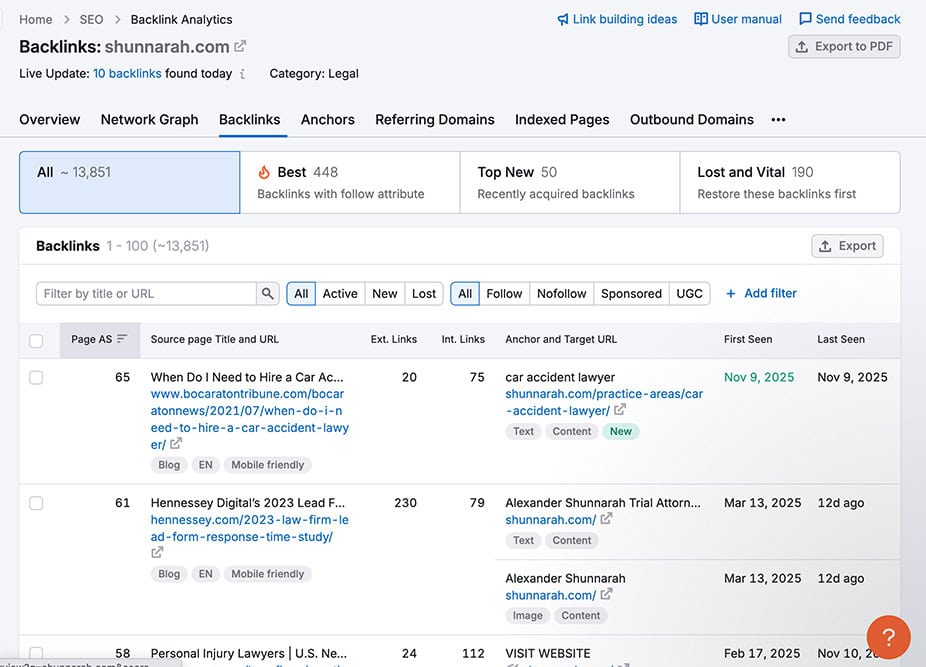
Look for patterns in the types of sites linking to them. Are they getting links from legal directories, news sites, industry publications, local business sites, or other sources?
Identify link opportunities that multiple competitors are using, as these may be relatively easy for you to replicate (such as certain legal directories or local business listings).
Also look for unique high-quality links that only one competitor has secured, as these could represent valuable opportunities if you can figure out how to earn similar links.
Understanding Google’s Ranking Factors
Google uses hundreds of ranking factors to determine which pages appear in search results, but some matter much more than others, especially for personal injury law firm sites.
Content Quality and Relevance
Google wants to show users the most relevant, comprehensive, and trustworthy content for their search query.
This means your content needs to thoroughly answer the question or address the need behind each keyword you’re targeting.
Length matters to some degree. Longer, more comprehensive content tends to rank better than thin content, particularly for competitive keywords, but quality always trumps quantity.
Your content should demonstrate genuine expertise in personal injury law, providing specific, actionable information that helps people understand their legal situation and next steps.
Avoid fluff, filler content, and generic information that could apply to any law firm or any practice area, instead focusing on specifics that showcase your knowledge and experience.
E-E-A-T: Experience, Expertise, Authoritativeness, and Trustworthiness
Google places enormous emphasis on E-E-A-T, particularly for “Your Money or Your Life” topics like legal matters that can significantly impact someone’s finances or wellbeing.
You need to demonstrate that you’re a qualified attorney with real experience handling personal injury cases, not just someone writing about legal topics.
Include attorney bios prominently on your site with detailed information about education, bar admissions, years of experience, case results, and any relevant awards or recognition.
Have all content written by or reviewed by actual attorneys, and include author bylines that link to attorney bio pages to establish credibility.
Build trust signals throughout your site with client reviews, case results, professional affiliations, and evidence of your involvement in the legal community.
Backlinks and Domain Authority
Backlinks from other websites remain one of the strongest ranking signals Google uses, particularly for competitive keywords in lucrative industries like personal injury law.
The quality of backlinks matters much more than quantity. One link from a highly authoritative site like a major news outlet or legal publication is worth more than dozens of links from low-quality directories.
Google looks at the authority of the linking domain, the relevance of the linking page to your content, the anchor text used in the link, and the overall context surrounding the link.
You can’t buy your way to the top with links alone, but you also can’t rank for competitive terms without a solid backlink profile that demonstrates your site is authoritative and trustworthy.
Focus on earning links naturally through great content, digital PR, relationship building, and creating resources that other sites want to reference.
User Experience and Technical Performance
Google has made it clear that user experience is a ranking factor, looking at metrics like page load speed, mobile usability, safe browsing, and intrusive interstitial usage.
Core Web Vitals, which measure loading performance, interactivity, and visual stability, are now confirmed ranking factors that you need to optimize for.
Sites that are slow, don’t work well on mobile devices, or provide a frustrating user experience will struggle to rank regardless of how good their content is.
Pay attention to on-page factors like proper heading structure, descriptive URLs, optimized images, and clean code that helps search engines understand your content.
The easier you make it for both users and search engines to understand your site, the better you’ll perform in search results.
Local Signals for Geographic Queries
Since most people searching for personal injury lawyers are looking for someone in their local area, Google pays close attention to local ranking factors.
Your Google Business Profile (formerly Google My Business) is crucial for appearing in the Local Pack and Map results that show up for location-based searches.
Consistent name, address, and phone number (NAP) information across your website and all online directories helps Google verify your location and show you for relevant local searches.
Reviews on Google and other platforms signal trust and authority, with both the quantity and quality of reviews significantly impacting your keyword rankings.
Local content that references your geographic area and demonstrates your connection to the community also helps establish relevance for local searches.
On-Page SEO: Optimizing Your Content for Rankings

On-page SEO refers to all the optimizations you make directly on your website’s pages to help them rank better in search results.
Title Tags and Meta Descriptions

Your title tag is one of the most important personal injury SEO ranking factors and appears as the blue clickable headline in search results.
Include your primary keyword near the beginning of the title tag, make it compelling enough to encourage clicks, and keep it under 60 characters to avoid truncation in search results.
For a car accident attorney page, a good title might be “Car Accident Attorney [City] | Free Case Review | [Firm Name]” rather than just “Car Accident Services”.
Meta descriptions don’t directly impact rankings but heavily influence click-through rates, which can indirectly affect rankings by signaling to Google that your result is valuable.
Write compelling meta descriptions of 150-160 characters that include your target keyword, explain what the page offers, and include a clear call to action.
Heading Structure and Content Organization
Use a clear heading hierarchy with one H1 tag per page that includes your primary keyword and describes what the page is about.
Break up your content with H2 and H3 subheadings that organize information logically and include related keywords where it makes sense naturally.
Don’t stuff keywords into headings unnaturally. They should read well for human visitors first and foremost, with SEO as a secondary consideration.
Good heading structure makes your content easier to read and helps search engines understand the main topics and subtopics covered on the page.
Avoid skipping heading levels (like going from H2 to H4) as this creates a poor structure that confuses both users and search engines.
Content Optimization Best Practices
Include your primary keyword in the first 100 words of your content to clearly establish what the page is about right from the start.
Use your target keyword naturally throughout the content without overusing it. Aim for a keyword density of around 1-2%, which means using it roughly once per 100 words.
Include semantic variations and related terms that provide context and help search engines understand your content’s relevance for related searches.
Tools like SurferSEO will identify these related terms automatically based on analysis of top-ranking pages, making it easy to ensure you’re covering all the important concepts.
Add internal links to related pages on your site using descriptive anchor text that includes relevant keywords without being over-optimized.
Images and Media Optimization
Every image on your site should have descriptive alt text that explains what the image shows, helping search engines understand the visual content and improving accessibility for visually impaired users.
Use descriptive file names for images before uploading them, such as “car-accident-scene-downtown-chicago.jpg” instead of “IMG_1234.jpg”.
Compress images to reduce file size without sacrificing noticeable quality, as large image files can significantly slow down your page load times.
Consider adding videos to your service pages, as video content tends to increase time on page and engagement, which are positive signals for SEO.
Include transcripts for any videos on your site, as this provides additional text content that search engines can crawl and index.
Technical SEO: The Behind-the-Scenes Elements

Technical search engine optimization covers all the backend optimizations that help search engines crawl, index, and understand your site more effectively.
Site Speed and Performance Optimization
Page speed is both a direct ranking factor and an important user experience element that affects bounce rate and conversions.
Use Google’s PageSpeed Insights tool to test your pages and get specific recommendations for improving load times.
Common speed improvements include enabling compression, minifying CSS and JavaScript, optimizing images, leveraging browser caching, and reducing server response time.
Consider using a content delivery network (CDN) like Cloudflare to serve your site’s static files from servers closer to each visitor’s geographic location.
Aim for a load time under three seconds on desktop and under four seconds on mobile, as slower speeds lead to higher bounce rates and lower conversions.
Mobile Optimization
With Google’s mobile-first indexing, your site’s mobile version is what Google primarily uses for ranking, making mobile optimization absolutely critical.
Use responsive design that automatically adapts your site’s layout to fit different screen sizes rather than serving separate mobile and desktop versions.
Test your site on actual mobile devices or using Google’s Mobile-Friendly Test tool to ensure everything displays correctly and is easy to use on small screens.
Make sure buttons and links are large enough to tap easily on a touchscreen and that text is readable without zooming.
Avoid using Flash or other technologies that don’t work on mobile devices, and ensure any pop-ups or interstitials don’t cover the main content on mobile screens.
XML Sitemaps and Robots.txt
Create and submit an XML sitemap to Google Search Console to help search engines discover all the pages on your site more efficiently.
Your sitemap should include all important pages you want indexed but exclude pages like thank-you pages, admin pages, or duplicate content that you don’t want appearing in search results.
The robots.txt file tells search engines which parts of your site they should and shouldn’t crawl, helping you control your crawl budget and prevent indexing of low-value pages.
Make sure your robots.txt isn’t accidentally blocking important pages or resources that Google needs to properly render your site.
Regularly check Google Search Console for crawl errors or indexing issues and fix them promptly to ensure all your important content is being indexed.
Schema Markup
Schema markup is structured data code you add to your pages to help search engines understand specific elements of your content.
For personal injury lawyers, the important schema types include LocalBusiness (to mark up your firm’s information), Attorney (for attorney bio pages), and LegalService (for service pages).
Schema can help you appear in rich results like knowledge panels and could give you an advantage in voice search results.
Use Google’s Rich Results Test tool to validate your schema markup and ensure it’s implemented correctly.
While schema isn’t a direct ranking factor, it helps search engines understand your content better and can improve your presence in search results.
HTTPS and Website Security
Having a secure site with HTTPS is both a ranking factor and essential for user trust, especially on a site where people might submit sensitive information through contact forms.
Install an SSL certificate on your site to enable HTTPS. Most hosting providers offer this for free through Let’s Encrypt.
Make sure all pages on your site use HTTPS and set up proper redirects from HTTP versions to HTTPS versions to avoid duplicate content issues.
Regularly update your website’s software, including your CMS, plugins, and themes, to patch security vulnerabilities that could be exploited by hackers.
Implement security best practices like strong passwords, two-factor authentication for admin accounts, and regular backups to protect your site from attacks.
Local SEO: Dominating Your Geographic Market

Local SEO for personal injury lawyers is particularly important since most of your clients will come from your specific geographic area.
Optimizing Your Google Business Profile
Optimizing your Google Business Profile is your most important local SEO task, determining whether you appear in the Local Pack and Map results for location-based searches.
Claim and verify your listing if you haven’t already, ensuring all information is accurate and complete including your business name, address, phone number, website, hours, and services offered.
Choose the most relevant primary category (typically “Personal Injury Attorney” or “Trial Attorney”) and add additional relevant categories to cover all your practice areas.
Upload high-quality photos of your office, team, and any other relevant images, as listings with photos get significantly more engagement than those without.
Post regular updates to your profile such as news about your firm, legal tips, case results, or community involvement to keep your profile active and engaging.
Managing and Generating Reviews
Reviews on your Google Business Profile are one of the most important local ranking factors and also heavily influence whether potential clients choose to contact your firm.
Actively encourage satisfied clients to leave reviews by sending follow-up emails after cases close or including review requests in your regular client communications.
Make it easy by providing direct links to your review page rather than making clients search for your business on Google.
Respond to all reviews, both positive and negative, to show that you value client feedback and are engaged with your online reputation.
Never buy fake reviews or offer incentives for positive reviews, as this violates Google’s guidelines and can result in penalties or suspension of your listing.
NAP Consistency Across the Web
NAP stands for Name, Address, and Phone number, and having consistent NAP information across all online directories and citations is crucial for local SEO.
Search engines use this consistency to verify your business’s legitimacy and location, so any discrepancies can hurt your local rankings.
Make sure your NAP information matches exactly across your website, Google Business Profile, Bing Places, legal directories like Avvo and Justia, local business directories, and any other sites where your firm is listed.
If you’ve moved offices or changed phone numbers, update every citation you can find with the new information to maintain consistency.
Use a local phone number rather than a toll-free number for your primary contact number, as local numbers provide a stronger geographic signal to search engines.
Building Local Citations
Citations are mentions of your firm’s NAP information on other websites, even if they don’t include a link back to your site.
Build citations on relevant legal directories like Avvo, Justia, Lawyers.com, and FindLaw, as well as general business directories like Yelp, Yellow Pages, and local chamber of commerce sites.
Look for niche and industry-specific directories that are relevant to personal injury law and your geographic area.
Don’t just focus on quantity. Quality matters, so prioritize citations on authoritative, well-maintained directories over low-quality spammy sites.
Use a citation tracking tool or spreadsheet to keep track of where you’ve built citations so you can maintain them if your information changes.
Creating Location-Specific Content
Create dedicated pages for each geographic area you serve, particularly if you serve multiple cities or have multiple office locations.
Each location page should have unique content that discusses your services in that area, references local landmarks or neighborhoods, and provides specific information relevant to that location.
Include your NAP information, a map, directions, parking information, and photos of that specific office if you have multiple locations.
Create blog content that references local events, news, or issues relevant to personal injury law in your area to further establish your local relevance.
Link to these location pages from your main navigation and from relevant service pages to help search engines understand your geographic focus.
Developing Your Content Strategy

A comprehensive content strategy is an essential part of SEO for personal injury lawyers, building authority and ranking for the wide range of keywords potential clients might search for.
Creating a Topical Map
A topical map is a comprehensive plan that outlines all the content you need to create to fully cover your practice area and related topics.
Start by mapping out your core service areas (car accidents, slip and falls, medical malpractice, etc.) as your main topic clusters.
Under each main topic, identify all the subtopics and related questions people might search for, creating a hierarchical structure that shows how everything relates.
For example, under “car accidents,” you might have subtopics like types of accidents, common injuries, determining fault, dealing with insurance, and the legal process.
Use keyword research tools to identify actual search queries related to each topic area, ensuring your map is based on real search demand rather than just what you think people might search for.
Prioritizing Content Creation
With potentially hundreds of topics to cover, you need a system for deciding what content to create first.
Prioritize commercial pages for your core services, as these are the pages most directly tied to generating new clients and revenue.
Next, focus on informational content that targets high-volume keywords closely related to your services, such as “what to do after a car accident” or “how much is my injury case worth”.
Create content that targets keywords you have a realistic chance of ranking for based on your current domain authority and competition level, rather than only chasing the most competitive terms.
Consider seasonal factors, for example, creating content about winter driving safety and ice-related accidents might be more timely in fall and early winter.
Balancing Commercial and Informational Content
Your content mix should include both commercial pages designed to convert visitors into clients and informational content designed to attract visitors and build trust.
Commercial pages directly describe your services and are optimized for transactional keywords like “[service] lawyer [city]” with clear calls to action to contact your firm.
Informational content answers questions and provides value without a hard sell, targeting keywords like “how to,” “what is,” “can I,” and other question-based queries.
The general rule is that you need several pieces of supporting informational content for every commercial page to build topical authority and attract personal injury clients who aren’t ready to hire yet.
Link from your informational content to relevant commercial pages naturally where it makes sense, providing a path for readers to learn more about your services if they’re interested.
Writing and Optimizing Commercial Pages

Your commercial pages are your most important content from a business perspective, as they’re designed to convert visitors into clients.
Identifying Which Commercial Pages to Create
Look at your keyword research to identify all the different services and case types that have sufficient search volume to justify dedicated pages.
At minimum, create car accident attorney pages and other major practice areas like truck accidents, motorcycle accidents, pedestrian accidents, slip and falls, and medical malpractice if you handle those cases.
Consider creating more specific pages for high-value or high-volume case types within each main category, such as “Uber accident lawyer” or “hit and run accident lawyer”.
Look at what pages your competitors have created and which ones are generating the most traffic for them to identify gaps in your own coverage.
Don’t create pages for services you don’t actually offer or case types you don’t want to handle just because they have search volume. Only create pages for services you genuinely provide.
Structure for Commercial Pages
Start with a compelling headline that clearly states what you offer and who you help, such as “Car Accident Lawyers in Chicago – Free Consultation”.
Follow with an introduction that explains the problem your personal injury clients are facing and how you can help them solve it.
Include a clear, prominent call to action above the fold (visible without scrolling) so visitors can immediately contact you if they’re ready.
Organize the rest of the content into logical sections with clear subheadings covering topics like types of cases you handle, your approach, what to expect, and why clients should choose your firm.
Focus your content on these pages on the services you offer and how you can help them, rather than on informational content (which you can include further down the page or in the FAQ). Remember, these pages are for commercial intent keyword searches, and people are looking for a service, so focus on that rather than education.
End with another strong call to action, your contact information, and trust signals like reviews, case results, or credentials.
Using SurferSEO to Optimize Service Pages
Run each commercial page through SurferSEO’s content editor to see how it compares to top-ranking competitors and what improvements you need to make.
Pay attention to the recommended word count. If top competitors have 2,500-word pages and yours has only 800 words, you probably need to expand your content significantly.
Include the related terms and phrases SurferSEO identifies, as these help search engines understand your content is comprehensive and relevant to the target keyword.
Follow the heading structure recommendations to ensure your content is well-organized and covers all the key topics search engines expect to see.
Don’t just chase a perfect SurferSEO score at the expense of readability, always prioritize creating content that serves your potential clients first and satisfies search engines second.
Key Elements to Include
Every personal injury attorney commercial page should include specific credentials and experience related to that practice area, such as number of cases handled, years of experience, or notable results.
Add client testimonials or reviews that specifically mention the type of case covered on that page to build trust and demonstrate your track record.
Include a section explaining your process or what clients can expect when they hire you, as this transparency helps build confidence and reduces barriers to contact.
Address common objections or concerns people might have about hiring a lawyer, such as cost, time commitment, or fear of dealing with legal proceedings.
Use calls to action throughout the page at natural points, not just at the top and bottom, giving visitors multiple opportunities to reach out.
Creating High-Quality Blog Content

Blog content serves multiple purposes: attracting organic traffic, building topical authority, and establishing your expertise in potential clients’ eyes before they’re ready to hire.
Choosing Blog Topics
Focus on topics that answer specific questions your personal injury clients are asking at various stages of their journey.
Early-stage content might cover topics like “what to do immediately after an accident” or “how to know if you have a valid personal injury claim”.
Mid-stage content could address questions like “how long does a personal injury case take” or “what evidence do I need for my case”.
Late-stage content might compare options like “should I hire a personal injury lawyer or handle my claim myself” or “how to choose the right injury attorney”.
Use keyword research to verify that people are actually searching for these topics and to identify specific keyword variations to target.
Writing Comprehensive, Valuable Content
Every blog post should thoroughly answer the question or address the topic in the title without requiring readers to visit other sites for more information.
Aim for at least 1,500-2,500 words for most blog posts covering substantive topics, as this length tends to perform better than shorter posts for competitive keywords.
Use specific examples, real situations, and actionable advice rather than generic information that could apply to any legal topic.
Break up text with subheadings, short paragraphs, and occasional lists where appropriate to maintain readability and make it easy for readers to scan.
Include internal links to related blog posts and relevant service pages to keep visitors on your site longer and guide them toward taking action.
Using AI to Accelerate Content Creation
AI tools like Claude can significantly speed up your content creation process when used correctly with proper prompting and human oversight.
Create a custom prompt that specifies your tone, style, structure, target audience, and key requirements like avoiding certain words or including specific elements.
Use AI to generate first drafts or outlines, then edit and refine the content to add your specific expertise, local details, and unique perspective.
Avoid publishing AI-generated content without substantial human review and editing, as AI can produce generic, inaccurate, or repetitive content if used without oversight.
The goal is to use AI as a tool to work faster and more efficiently, not to replace the human expertise and authenticity that makes your content valuable.
Optimizing Blog Posts for SEO
Include your target keyword in the blog post title, URL, first paragraph, at least one subheading, and naturally throughout the content.
Add 2-3 internal links to relevant service pages or other blog posts using natural anchor text that includes relevant keywords.
Include at least one external link to a high-quality, authoritative source that supports a claim or provides additional context.
Optimize your featured image with a descriptive file name and alt text that includes your target keyword where appropriate.
Write a compelling meta description that includes your keyword and encourages clicks by explaining what unique value your post provides.
Link Building Strategies for Personal Injury Firms

Backlinks remain one of the most important ranking factors, but link building for law firms requires a strategic approach.
Understanding Different Types of Links
Editorial links are the gold standard. These are links that other sites give you naturally because your content is valuable and worth referencing.
Manual outreach links come from proactive relationship building where you reach out to relevant sites and provide a reason they should link to you (often a financial incentive).
Directory links come from legal directories and business listings where you create a profile that includes a link back to your site.
Guest post links come from contributing articles to other websites in exchange for an author bio link or contextual link within the content.
Partnership links come from relationships with other businesses, organizations, or attorneys who have complementary practices and audiences.
Earning High-Quality Editorial Links
Create exceptional resources that provide genuine value and are worth linking to, such as comprehensive guides, research studies, legal resources, or tools.
Develop relationships with journalists and bloggers who cover legal topics, offering yourself as an expert source for comments on relevant news stories.
Monitor media requests on platforms like HARO (Help a Reporter Out) where journalists seek expert sources for articles they’re writing.
Create data-driven content with original research, surveys, or analysis that provides new insights other sites will want to reference and cite.
Share newsworthy stories about your firm, significant case results, or your involvement in important legal issues that might attract media coverage.
Creating Linkable Assets
Develop resources that are so useful other sites naturally want to link to them, such as legal calculators, settlement estimators, or comprehensive checklists.
Create visual content like infographics that explain complex legal processes or statistics about personal injury cases in an easily digestible format.
Publish in-depth guides that become the definitive resource on specific topics within personal injury law.
Develop free tools or resources that help people with specific tasks related to their injury claims or legal questions.
Make these resources easy to embed or share with embed codes for infographics or simple share buttons for guides and tools.
Legal Directory and Citation Links
Claim and complete profiles on major legal directories like Avvo, Justia, Lawyers.com, FindLaw, and Martindale-Hubbell.
While these directory links may not be as powerful as editorial links, they’re relatively easy to obtain and contribute to your overall link profile.
Fill out profiles completely with detailed information, photos, practice areas, and any credentials or awards that help your profile stand out.
Monitor and respond to any reviews or questions on these platforms to maintain active, high-quality profiles.
Look for state and local bar association directories and other professional organization listings that might offer link opportunities.
Grey Hat vs. White Hat vs. Black Hat Tactics
White hat tactics follow search engine guidelines completely, focusing on creating value and earning links naturally through quality content and outreach.
Black hat tactics explicitly violate search engine guidelines through practices like buying links, using private blog networks, or automated link schemes that can result in severe penalties.
Grey hat tactics exist in a nebulous area that might not explicitly violate guidelines but could be considered manipulative, such as reciprocal link exchanges or low-quality guest posting.
For law firms, the risk of black hat tactics far outweighs any potential short-term gains, as a penalty could devastate your online presence and client acquisition.
Stick to white hat tactics and perhaps occasional grey hat approaches that carry minimal risk, prioritizing building a sustainable link profile that will stand the test of time.
Optimizing for AI-Powered Search

With the rise of AI-powered search through tools like ChatGPT, Google’s AI Overviews, and other AI assistants, you need to consider how your content appears in these systems.
How AI Search Differs From Traditional Search
AI-powered search systems synthesize information from multiple sources to provide direct answers rather than just showing a list of links.
This means users might get answers without ever clicking through to your site, changing how you think about content strategy and optimization.
AI systems prioritize clear, authoritative, well-structured content that directly answers questions without unnecessary fluff or sales language.
Featured snippets and structured content are particularly important, as AI systems often pull from these elements when generating responses.
Your content needs to be comprehensive enough to be seen as authoritative but also well-organized so AI systems can extract specific information efficiently.
Optimizing Content for AI Systems
Structure your content with clear headings that directly state what each section covers, making it easy for AI to identify relevant information.
Answer questions directly and succinctly at the beginning of sections before expanding into more detail, as AI systems often prioritize these clear, direct answers.
Use schema markup to help AI systems understand the structure and meaning of your content more effectively.
Create FAQ sections with clear question-and-answer formats, as these often get pulled into AI responses and featured snippets.
Ensure your content is cited properly with clear authorship and expertise signals, as AI systems increasingly consider E-E-A-T when selecting sources.
Maintaining Your Presence in an AI Search World
Even as AI answers become more prominent, there will still be a need for detailed, expert content that AI systems reference as sources.
Focus on building brand awareness and direct traffic so people seek out your firm specifically rather than relying solely on organic search discovery.
Create content that provides value beyond what a quick AI answer can offer, such as specific case analysis, strategic advice, or local expertise that requires deep knowledge.
Consider how potential clients might phrase questions to AI assistants and ensure your content covers these conversational, natural language queries.
Monitor how your content appears in AI-powered results and adjust your strategy based on what types of content and formats these systems are preferring.
The Role of Social Media and Other Ranking Factors

While social media isn’t a direct ranking factor, it can indirectly impact your SEO through various mechanisms.
Social Signals and SEO
Social media doesn’t pass traditional link equity like backlinks do, but social shares can increase content presence and potentially lead to earned links.
Content that performs well on social media tends to get more eyes on it, increasing the chances that bloggers, journalists, or other site owners will discover and link to it.
Social profiles often rank in search results for your firm’s name, helping you control more of the first page and present a comprehensive online presence.
Active social media engagement demonstrates that your firm is established and actively working with clients, which can indirectly influence trust and authority signals.
Regular social media content keeps your brand present and can drive direct traffic that impacts user engagement metrics Google may use as ranking signals.
Brand Building and Its SEO Impact
Building a strong, recognizable brand creates more branded searches, which Google views as a strong trust signal.
When people search specifically for your firm by name rather than just generic keywords, it signals to Google that you’re an established, trusted entity.
Brand mentions across the web, even without links, can contribute to your overall authority and relevance in Google’s eyes.
A strong brand also increases click-through rates from search results since people are more likely to click on firms they recognize.
Invest in building your brand through social media, content marketing, community involvement, and traditional marketing to create these positive brand signals.
Other Factors That Can Impact Rankings
Your firm’s physical location and actual service area affect your ability to rank for local searches in different geographic regions.
The age of your domain can play a role, as older, established domains tend to have built up more authority over time than newer ones.
Click-through rate from search results may influence rankings, as high CTR signals that your result is valuable for that particular query.
Dwell time and bounce rate indicate whether visitors find your content valuable, with longer visits and lower bounce rates being positive signals.
Staying up to date with Google algorithm updates and adjusting your strategy as needed helps ensure you don’t get caught by changes that penalize outdated tactics.
Need Help Dominating SEO for Your Personal Injury Practice?
Building a successful SEO strategy for a personal injury law firm requires significant time, expertise, and ongoing effort across multiple channels.
As a SEO agency specializing in personal injury law firms, Dominate Marketing can help you implement all the strategies covered in this guide without the years of trial and error.
We understand the unique competitive landscape of personal injury law and have helped numerous law firms increase their client intake through strategic, results-focused SEO.
Unlike generic marketing agencies that apply the same approach to every industry, we specialize exclusively in legal marketing and know exactly what it takes to compete in your market.
Contact us today by filling out the form below to discuss how we can help you dominate search results for personal injury keywords in your area.