

If you run a personal injury firm and your website looks fine but the phone isn’t ringing, you’re about to discover exactly why cases are going to your competitors instead of you.
Most attorneys waste time and money on generic SEO audits that produce 50-page PDFs no one reads.
In this guide, you’ll learn how to audit your own PI website in four simple steps and identify the exact problems costing you cases.
Step 1: How Google Sees Your Personal Injury Website
The first step in any SEO audit is understanding where you actually rank when potential clients search for your services.
Open an incognito browser window and search for the keywords you want to rank for, such as “car accident lawyer [your city]” and “personal injury lawyer [your city]” to see where your firm appears in the results.
If you’re not on page one for these high-intent searches, nothing else matters because this is where the highest value cases start their search.
Check Your Index Coverage
Type “site:yourdomain.com” into Google to see which pages Google has actually indexed from your website.
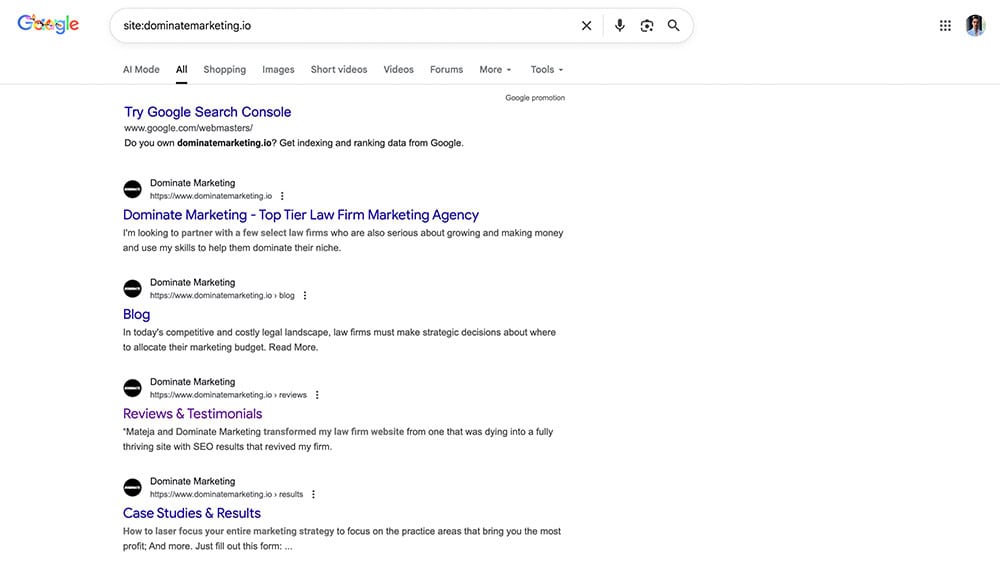
This search will show you whether Google can find and understand your content, and it often exposes weird URLs, duplicate pages, or content that shouldn’t be public.
Many PI firms discover they have dozens of thin pages or broken URLs that confuse Google and dilute their ranking power.
If you see pages you don’t recognize or URLs that look like gibberish, you’ve found your first problem.
Analyze Your Current Rankings
Look carefully at which firms appear above you in the search results for your target keywords.
Note what they’re doing differently on their title tags, URLs, and meta descriptions that appear in the search results.
These competitors are winning cases that should be yours, and understanding their strategy is the first step to overtaking them.
Pay special attention to law firms that have been around for less time than you but still rank higher.
They are clearly doing something right with their SEO.
2. How Local Clients Find You Online
Local search results are critical for personal injury attorneys because most clients search for lawyers near them.
When someone searches “car accident lawyer near me” or includes a city name, Google shows a map pack with three local businesses before the regular search results.

If your firm isn’t in that map pack, you’re invisible to a huge portion of potential clients who will hire one of the three firms they see.
Google Business Profile Optimization
Your Google Business Profile is often the first impression potential clients have of your firm, so every detail matters.
Check whether you’ve selected “Personal Injury Attorney” as your primary category, because the wrong category can completely tank your profile’s rankings.
Look at your business description and make sure it clearly explains what types of cases you handle and what makes your firm different from competitors.
Many PI firms use generic descriptions that could apply to any attorney, which wastes valuable space to connect with ideal clients.
Review Quality and Quantity
Count how many Google reviews you have compared to the firms ranking above you in the map pack.
Reviews are one of the top ranking factors for the GBP.
Google heavily weighs the number and recency of reviews when deciding which law firms to show in local results.
If a competitor has 200 reviews and you have 15, that gap directly explains why they appear in the map pack and you don’t.
Start implementing a review collection process immediately because this single factor can double or triple your incoming case inquiries.
Your Profile Completeness
Check whether you’ve filled out every section of your Google Business Profile, including services, photos, hours, and attributes.
Google rewards complete profiles with better rankings, and potential clients trust firms that provide comprehensive information.
Upload photos of your office, your team, and even case results if bar rules allow it in your state.
A bare-bones profile signals to both Google and potential clients that you don’t care about your online presence, which makes them question whether you’ll care about their case.
3. Money Pages Performance Analysis
Your practice area pages are where you convert traffic into cases, so these pages need to be absolutely perfect.
Most personal injury websites have thin, generic pages that do nothing to rank on Google, nor convince a potential client to call them instead of clicking back and going to a competitor instead.
Content Depth and Quality
Open your “Car Accident” or main personal injury page and compare it side-by-side with a top-ranking competitor’s page.
Count the word count on both pages.
If yours is 300 words and theirs is 2,000+ words with clear sections about what they do, who they help, why choose them and so on, you’ve found a major problem.
Google wants to send searchers to the most comprehensive, helpful resource, not a thin page that barely explains what you do.
Your content needs to demonstrate expertise by covering subtopics like types of injuries and cases you handle, the services you offer, your unique selling points, case studies and so on.
This depth not only helps you rank but also educates potential clients and builds trust before they ever call.
Title Tags and Headlines
Check whether your page title and H1 headline clearly state “Car Accident Lawyer [Your City]” or something similarly specific.
Vague titles like “Auto Injuries” or “Vehicle Accidents” don’t match what people actually search for, which means you lose rankings and confuse visitors.
Your page title appears in search results and browser tabs, while your H1 headline is the first thing visitors see on the page, so both need to immediately confirm they’re in the right place.
If your competitor’s headline is clearer and more specific than yours, and includes the right keywords, they’re winning cases simply because their messaging is better.
Internal Linking Structure
Check whether your homepage, other practice area pages, and blog articles link to your main personal injury pages.
Many PI websites treat their practice area pages like orphans that nobody links to, which tells Google these pages aren’t important.
Create a clear linking strategy where your homepage links to all main practice areas, and related pages link to each other with descriptive anchor text.
For example, your “Car Accident Lawyer” page should link to your “Truck Accident Lawyer” page, and your blog articles about car accidents should link back to your main service page.
Supporting Content Strategy
Look at whether you have blog articles or resource pages that support your main practice area pages.
Top-ranking PI firms publish detailed guides answering questions like “What is my car accident case worth?” or “How long does a personal injury case take?”.
These articles attract traffic from people researching their options, and they build topical authority that helps your main pages rank better.
If you only have practice area pages with no supporting content, you’re missing a huge opportunity to capture cases at every stage of the research process.
Calls to Action and Conversion Elements
Scroll through your money pages and note where phone numbers, contact forms, and chat options appear.
Look for trust signals like case results, awards, years of experience, and client testimonials that give visitors confidence to call.
Your primary call to action should appear above the fold so mobile users see it immediately without scrolling.
Check whether your contact forms are simple and quick to fill out, because every extra field you require loses you cases to competitors with easier forms.
Users should never have to search for a way to contact you, it should be immediately obvious at all times.
This may sound simple, but this alone greatly increases the amount of people who will contact you.
4. Technical SEO Sanity Check
You don’t need to do a 102-point technical audit, but you do need to verify that Google can actually crawl and index your site properly.
Many PI websites have basic technical issues that prevent them from ranking no matter how good their content is.
Mobile Friendliness
Pull up your website on your phone right now and try to use it like a potential client would.
Can you easily read the text without zooming, press buttons without accidentally hitting the wrong thing, and call or navigate to the contact form quickly?
Most personal injury case inquiries now come from mobile devices, so if your site doesn’t work perfectly on phones, you’re turning away cases every single day.
Page Speed Performance
Run your main pages through Google PageSpeed Insights to see how fast they load on mobile and desktop.
If your pages take more than 3 seconds to load, potential clients are hitting the back button and choosing a competitor with a faster site.
Common speed problems include oversized images, too many plugins, and bloated code that your developer can fix relatively easily.
Speed might not seem that important, but it directly impacts both your Google rankings and your conversion rate.
Indexation Issues
Go to Google Search Console and check the “Coverage” or “Pages” report to see if Google is having trouble crawling or indexing your pages.

You might discover that your most important pages are blocked by robots.txt, marked as noindex, or returning error codes that prevent Google from ranking them.
Many law firms accidentally block their practice area pages or set them to noindex during website development and never fix it.
These issues are simple to resolve once you know they exist, but they completely destroy your SEO if left unfixed.
The Three Priority Fixes for PI Attorneys
After running this audit, you might feel overwhelmed by all the problems you’ve discovered.
Rather than trying to fix everything at once, focus on the three changes that will have the biggest immediate impact on your case flow.
1. Fix Your Google Business Profile First
Getting into the local map pack is the fastest way to increase case inquiries because these results appear before organic results.
It’s also very quick and easy to do.
Make sure your primary category is correct, your description is compelling, and you’re actively collecting reviews from satisfied clients.
This change can start bringing you more cases within 2-4 weeks, which is much faster than waiting for organic SEO improvements.
Many PI attorneys see a 50-100% increase in case inquiries just from optimizing their Google Business Profile properly, so it’s well worth doing.
2. Improve Your Main Practice Area Pages
Expand your main service pages to at least 1,500-2,000 words with clear sections answering common client questions.
Make sure your title tags and headlines include your target keywords and location, and add strong calls to action above the fold.
These pages are your highest-value targets because they capture people ready to hire an attorney right now.
Even modest improvements to these pages can result in better rankings and more conversions within 60-90 days.
3. Start Publishing Supporting Content
Create a content calendar to publish at least 4 helpful articles per month answering questions your potential clients are searching for.
Each article should target a specific question like “What should I do after a car accident?” or “How much is my injury case worth?”
Link these articles back to your main practice area pages to strengthen their authority and capture traffic at every stage of the client journey.
This strategy builds momentum over time, with each article contributing to your overall domain and topical authority and bringing in more potential cases.
Get Expert Help With Your Personal Injury SEO
Running your own SEO audit gives you valuable insight into why your phone isn’t ringing, but fixing these issues requires specialized knowledge and consistent execution.
Most personal injury attorneys don’t have time to become SEO experts while also running their practice and serving clients.
SEO agency for personal injury lawyers, we can take this entire burden off your plate and get you ranking for the cases you actually want.
We’ve helped dozens of firms increase their monthly case intake by an average of 300% within 12 months using the exact strategies outlined in this guide.
Contact us today by filling out the form below and we’ll help you dominate your local market and attract more high-value personal injury cases.