

If your personal injury law firm’s website looks good but still doesn’t bring in cases, the problem is almost never the design.
Nine times out of ten, the real issue is your on-page SEO.
On-page SEO is how you structure and optimize individual pages so Google understands what they are about and ranks them for the right searches.
This guide will walk you through exactly how to fix your on-page SEO so your firm shows up when injured clients search for help in your area.
Meta Titles, Descriptions, and URLs
These three elements are the first thing both Google and users see of every page on your site.
They tell both Google and potential clients what your page is about before anyone even clicks.
Getting them right is one of the fastest ways to improve your rankings and click-through rates.
Meta Titles
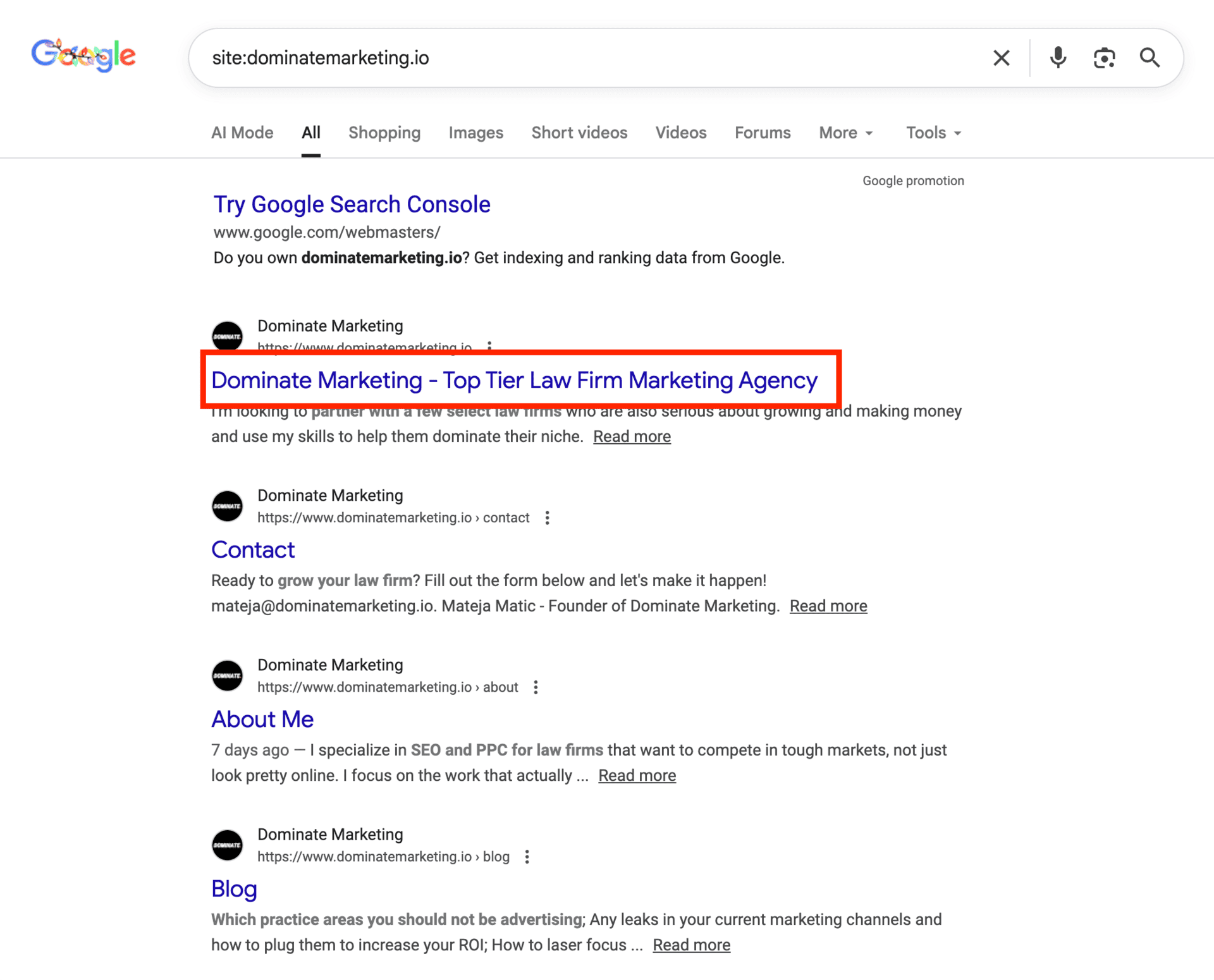
Your meta title is one of the single biggest on-page ranking factors you can control.
It appears as the clickable headline in Google search results, and it tells the search engine exactly what your page is about.
A weak title looks like this: “Home | Smith & Associates.”
That title tells Google nothing about what you do or where you do it.
A strong title looks like this: “Houston Car Accident Lawyer | Free Consultation | Smith & Associates.”
This title includes the main keyword, the city, a benefit, and the firm name.
Here are the rules to follow for every meta title you write:
- Put your main keyword and city at the front of the title.
- Keep the total length between 50 and 60 characters so it does not get cut off in search results.
- Place your firm name at the end (optional – prioritize keywords over firm name).
- Make sure every page on your site has a unique title so you do not compete against yourself in the rankings (keyword cannibalization)
Meta Descriptions
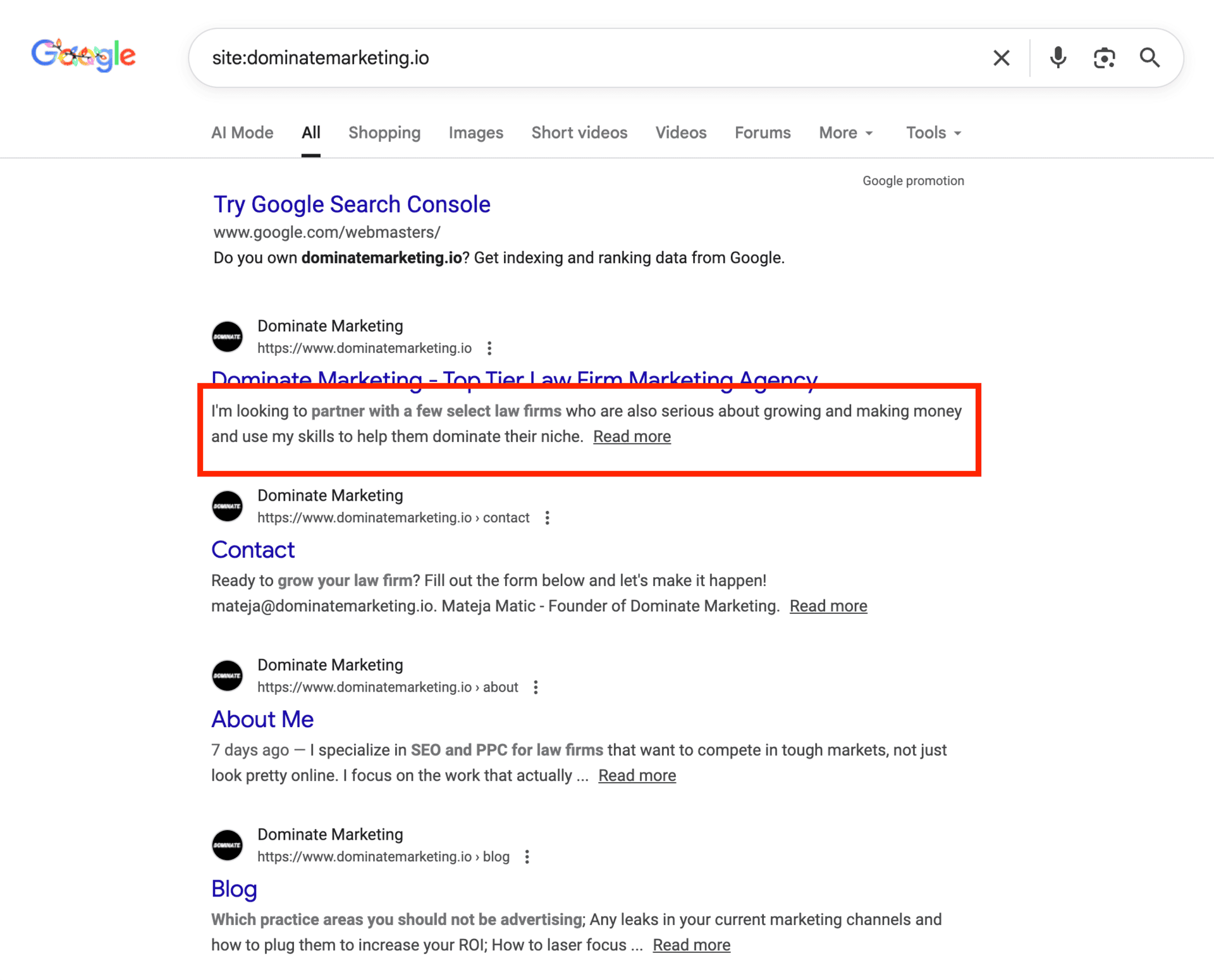
Meta descriptions do not directly affect your rankings, but they have a major impact on whether people click through to your site.
Think of your meta description as a mini advertisement for your page that shows in the Google search results below your meta title.
A weak description sounds like this: “We are a personal injury law firm dedicated to excellent service.”
That tells potential clients nothing specific about what you offer or why they should choose you.
A stronger description sounds like this: “Injured in a Houston car crash? Our personal injury lawyers have recovered millions for clients like you. No fee unless we win. Call 24/7.”
This version speaks directly to the injured person, highlights a result, removes risk with the contingency fee mention, and includes a clear call to action.
As a general rule, keep your meta descriptions between 150 and 160 characters to avoid truncation on the Google SERPs.
URL Structure
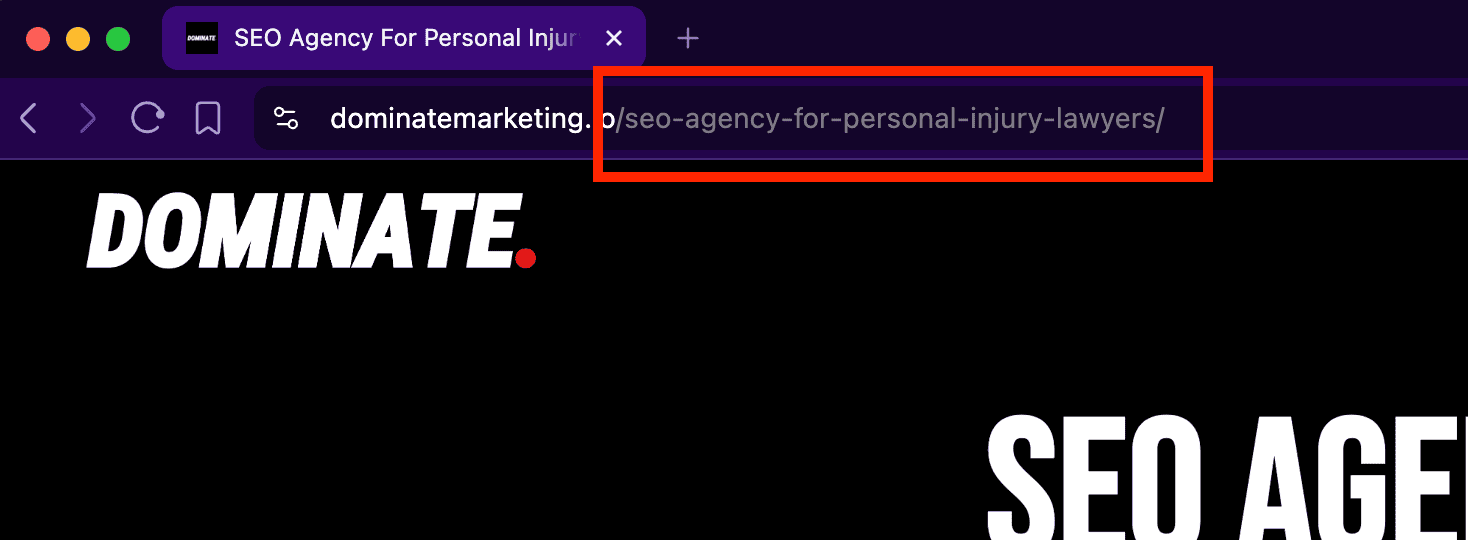
Your URLs are another major on-page ranking factor that many law firms overlook.
A clean URL tells Google and users exactly what the page is about.
A badly optimized URL looks like /services/page1?id=37, or /criminal law.
These URLs are either confusing, unclear as to the intent of the page, or give no SEO value.
A good URL looks like this: /car-accident-lawyer-houston.
This URL is short, readable, and includes the target keyword. It’s also abundantly clear what this page is about.
As a general rule, avoid using dates, random parameters, or unnecessary folder structures in your URLs, and try to keep them as short as possible (3-6 words) is ideal.
Some SEOs prefer URLs that come directly off the root domain (myself included), while others use folder structures.
Both can work, but the key is to keep them clean and keyword-focused without stuffing multiple keywords into a single URL.
Headings and Page Structure
Your headings create the outline of your page.
They help Google understand the hierarchy of your content and make it easier for visitors to scan and find what they need.
The H1 Tag
Every page on your site should have exactly one H1 tag.
The H1 is the main headline of the page and should include your primary keyword. The H1 heading is as important as your meta title and URL.
For a car accident practice page in Houston, your H1 might be: “Houston Car Accident Lawyer.”
Do not use multiple H1 tags on a single page, as this confuses search engines about what the page is primarily about.
The H1 is one of the three biggest on-page SEO factors you can control, along with your meta title and URL, so spend the time to make sure it’s perfect.
H2 and H3 Tags
Your H2 tags are the main sections of your page.
For a personal injury practice page, your H2s might include sections like “Car Accident Injury Services We Offer” “Common Injuries We Handle,” “Why Choose Our Firm,” and “Frequently Asked Questions.”
Your H3 tags are sub-points that fall under each H2 section.
For example, under an H2 about common injuries, you might have H3s for “Whiplash and Neck Injuries,” “Traumatic Brain Injuries,” and “Spinal Cord Damage.”
Here is a simple test to check if your heading structure is working.
If someone skims only your headings without reading the body content, can they understand what the page covers and how it flows?
If not, you need to restructure your headings.
Writing Service Page Content
Your service pages, also called money pages, are where visitors decide whether to contact your firm.
Most personal injury websites have service pages that read like weak blog posts with no clear direction.
They fail to speak to the injured person or give them a reason to pick up the phone.
Here is how to write service pages that actually convert.
Headlines and Opening Sections
Your H1 headline should be clear, keyword-based, and benefit-oriented.
Something like “Los Angeles Car Accident Lawyer” works because it tells the visitor exactly what the page is about.
The more unique, clear, and compelling your headline, the better it will perform, so you can get a bit more creative with it and do something like “No Win No Fee Los Angeles Car Accident Lawyers”, as an example.
Your opening section appears above the fold, which means visitors see it before they scroll.
Write two to three paragraphs that speak directly to someone who was just injured.
Address their pain points, their fears, and why they need a good lawyer on their side.
Include one strong call to action in this section that takes them to a click-to-call button or a short contact form.
Content Intent and Key Information
You are not writing a law review article.
You are answering three questions that every injured person has: Can you help me? Do you handle cases like mine? What happens next?
All of your content must focus on commercial intent, which means selling your services to someone who needs them right now.
Here is the key information to include on every service page.
Explain what types of cases you handle, such as car accidents, rideshare accidents, rear-end collisions, or truck accidents.
Describe who you help, including injured drivers, passengers, pedestrians, and cyclists.
Outline what you actually do for clients, including investigating the accident, negotiating with insurance companies, and litigating when necessary.
Tell them what to do right now, such as not speaking to the insurance company first and collecting evidence at the scene.
Include proof of your results within bar rules, your years of experience, client testimonials, and any badges or awards.
When possible, include photos of the attorneys and team because people hire people, not faceless firms.
Calls to Action
Do not make the mistake of putting a single “Contact Us” button at the bottom of the page and calling it done.
You need clear calls to action throughout the entire page.
After every major section, include a button or text CTA like “Call now for a free consultation” or “Schedule your free case review today.”
When you write your content, think about a scared, injured person sitting in a hospital bed looking at your site on their phone.
They are not reading every word.
They are scanning for a reason to trust you and a way to contact you.
Make both of those things easy to find.
Images and Alt Text
Images help build trust with potential clients, but they can hurt your SEO if you ignore the technical details.
Use real photography wherever possible.
Photos of your office, your team, and your city build more trust than generic stock photos of people shaking hands.
Compress your images before uploading them to your site so they load quickly.
Slow-loading images hurt your page speed scores (which directly impacts your rankings) and frustrate mobile users.
Name your image files with descriptive, keyword-rich names before uploading.
A file named “houston-car-accident-lawyer-office.jpg” is far better than “IMG_3728.jpg.”
Write alt text for every image on your core pages.
Alt text describes the image in plain English and provides context for search engines and visually impaired users.
A good alt text might read: “Attorney John Smith, Houston car accident lawyer, meeting with a client in his office.”
Every image on your service pages should have meaningful alt text that describes what is in the image and relates it to your practice.
Internal Links
Internal links are how you tell Google which pages on your site are most important and relate to each other.
They also help visitors move through your site and find related information.
Link from your home page and main navigation to each of your primary practice pages.
From your blog posts and FAQ pages, link back to your relevant service pages using descriptive anchor text.
This creates a silo and helps to establish topical authority within that specific topic (car accidents, for example).
Instead of linking with generic text like “click here” or “read more,” use anchor text that includes your target keyword, such as “Houston car accident lawyer.”
Avoid creating orphan pages, which are pages on your site with zero internal links pointing to them.
If Google cannot find a page through your internal link structure, it will have a hard time understanding that the page is important.
Conversion Optimization for Your Pages
This section is not traditional SEO, but it is where you turn your rankings into actual revenue.
You can rank first in Google for every keyword you want, but if visitors do not convert into leads, those rankings are worthless.
On every key personal injury page, especially on mobile, make sure your phone number is visible and click-to-call.
Include a short, simple contact form that asks only for name, contact information, and a brief description of their situation.
Display clear risk reversal messaging near your calls to action, such as “No fee unless we win” if your jurisdiction allows it.
Place social proof near your CTAs, including review ratings, client testimonials, and trust badges.
Make sure your pages load fast and do not force visitors to fight through pop-ups or slow animations.
Here is a simple way to think about conversion optimization: If you doubled your conversion rate from visitors to leads, you would double the return on every dollar you spend on SEO without moving a single ranking. So it’s well worth doing.
Important Factors to Consider When It Comes to On-Page SEO
Before you start making changes to your site, make sure your technical SEO foundation is solid.
Check for crawl errors, indexing problems, and Core Web Vitals issues.
If your site has technical problems, fixing your on-page SEO will not deliver the results you expect.
On-page SEO is not a one-time task.
You should audit your pages regularly to make sure your meta titles, headings, and content stay aligned with your target keywords and current best practices.
Track your rankings and conversions so you can see which pages are performing and which need more work.
Consider your competitors as well.
Look at what the top-ranking firms in your market are doing with their on-page SEO.
Analyze their titles, headings, content structure, and calls to action to find opportunities where you can do better.
Need Help With Your On-Page SEO?
On-page SEO for personal injury firms comes down to clear titles and headings, strong client-focused service pages, clean images with proper alt text, strategic internal links, and mobile-friendly calls to action.
Getting these elements right will help your pages rank higher and convert more visitors into signed cases.
We at Dominate Marketing are an SEO agency for personal injury law firms, and will ensure this is all done to the highest standard on your site if we work together.
Contact our team today by filling out the form below to discuss how we can help your firm get more cases from organic search.