

Google reviews are one of the most powerful ranking signals personal injury law firms can control, directly influencing where you appear in Google’s local Map Pack results.
According to Whitespark’s 2026 Local Search Ranking Factors survey, review signals now account for approximately 16-20% of local pack ranking factors, making them the second most influential factor behind proximity.
On top of that, BrightLocal’s 2026 Local Consumer Review Survey found that 97% of consumers read online reviews before choosing a business, with 41% saying they “always” read reviews when browsing.
For personal injury firms that depend on local search to attract new clients, having a strong Google reviews strategy isn’t optional.
It’s a ranking factor, a trust signal, and a conversion driver all in one.
This article covers why Google reviews matter so much for personal injury firms, how to systematically generate more of them, and the specific steps you can take to turn your review profile into a competitive advantage.
Why Do Google Reviews Matter So Much for Personal Injury Law Firm Rankings?
Google reviews directly impact where your firm shows up in local search results, particularly in the Map Pack that appears at the top of the page when someone searches for a personal injury lawyer in your area.
Google’s own documentation states that local rankings are determined by three factors: relevance, distance, and prominence.
Under prominence, Google explicitly says that “Google review count and review score factor into local search ranking” and that “more reviews and positive ratings can improve your business’ local ranking.”
This means reviews aren’t just a nice-to-have for building trust with potential clients.
They’re a confirmed ranking signal that Google uses to decide which firms appear at the top of local search results and which ones get buried below the fold.
The Map Pack is the most valuable real estate in local search for personal injury attorneys because it appears above organic results and includes your firm’s name, rating, review count, phone number, and location.
Firms that rank in the Map Pack’s top three positions receive significantly more clicks, calls, and website visits than firms ranked below them.
If your competitors have 150 reviews with a 4.8-star average and your firm has 12 reviews with a 4.5-star average, the reviews gap alone could be keeping you out of those top positions.
How Do Google Reviews Influence the Map Pack Specifically?
Google evaluates multiple review signals when determining Map Pack rankings, not just the total number of reviews your firm has.
The main review signals Google considers include review volume (how many reviews you have), review velocity (how consistently you receive new reviews), your average star rating, the content of the reviews themselves, and how frequently you respond to them.
Review volume establishes credibility in Google’s eyes.
A Sterling Sky case study from 2025 found that businesses experienced noticeable ranking improvements when they reached 10 reviews, confirming that even a relatively small number of reviews can move the needle.
However, for competitive industries like personal injury law, you’ll likely need far more than the minimum to compete.
Your average star rating matters too, but not in the way most firms think.
A perfect 5.0 rating with only a handful of reviews won’t outperform a 4.7 rating backed by hundreds of reviews.
According to BrightLocal’s 2026 survey, 31% of consumers in 2026 only consider businesses with a 4.5-star rating or higher, and 68% of consumers won’t use a business rated below four stars.
The sweet spot for personal injury firms is maintaining a rating above 4.5 stars while continuously building review volume.
How Important Is Review Recency for Personal Injury Firms?
Review recency is one of the most underrated ranking factors in local search, and it’s especially relevant for personal injury firms that may have long case durations between potential review opportunities.
Review velocity is just as important as total volume.
Whitespark has noted that the moment you stop getting new reviews, your local rankings will likely start to slip.
Google wants to see that your firm is actively serving clients, and a steady stream of fresh reviews is one of the strongest signals of an active, thriving business.
A firm that received 50 reviews three years ago and hasn’t gotten any since is going to lose ground to a firm with 40 reviews that receives two to three new ones every month.
BrightLocal’s 2026 survey found that 74% of consumers only care about reviews written within the last three months.
This means that even a firm with 200 total reviews could lose ground if none of those reviews are recent.
A competing firm with 80 reviews that includes 10 from the past month will likely appear more active, trustworthy, and relevant to both Google’s algorithm and potential clients.
For personal injury firms, maintaining review recency requires planning because cases can take months or even years to resolve.
Not every review has to come from a settled case.
You can also ask clients for reviews at other positive touchpoints during the legal process, such as after a particularly helpful consultation, after a successful motion, or after a milestone event in their case.
The goal is to maintain a steady cadence of at least one to two new reviews per month, though more is better in competitive markets.
If you’re in a major metro area competing against firms that generate five to ten new reviews monthly, you need to match or exceed that pace to maintain your position in the Map Pack.
How Can Personal Injury Firms Build a Systematic Review Generation Process?
The most effective way to get more Google reviews is to build a repeatable system that makes asking for reviews a standard part of your case resolution process, not something you remember to do occasionally.
Personal injury cases have a natural review trigger point: the moment a case reaches a successful settlement or verdict.
This is when your client feels the most relief, the most gratitude, and the most willing to share their experience publicly.
If you wait days or weeks after this moment, the emotional momentum fades and the chances of getting a review drop significantly.
The first step is to make review requests a non-negotiable part of your case closing process.
Every single client who has a successful outcome should be asked for a review.
You don’t need to be pushy about it.
A simple, honest explanation of why reviews matter to your firm is usually enough to motivate clients who had a positive experience.
Something like: “We’re glad we could help you. If you have a few minutes, leaving us a Google review would mean a lot. It helps other people in similar situations find us.”
Assign this responsibility to a specific person at the firm, whether it’s the attorney, the paralegal, or a dedicated staff member.
If no one is specifically responsible for asking, it won’t happen consistently.
What Is the Best Way to Share Your Google Review Link with Clients?
Making the review process as easy as possible is critical because every extra step you require reduces the number of clients who actually follow through.
Google provides a direct review link through your Google Business Profile that takes clients straight to the review form, bypassing the need to search for your firm and find the review button on their own.
To find your review link, log into your Google Business Profile, click on “Read Reviews,” and then select “Get more reviews.”
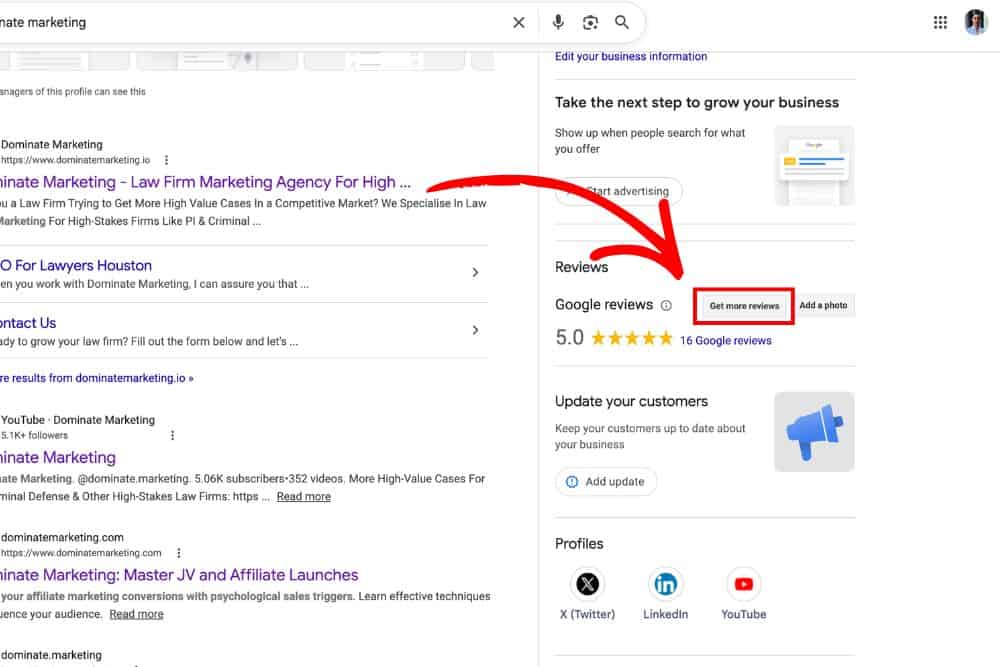
You’ll see a shareable link that you can copy and send directly to clients.
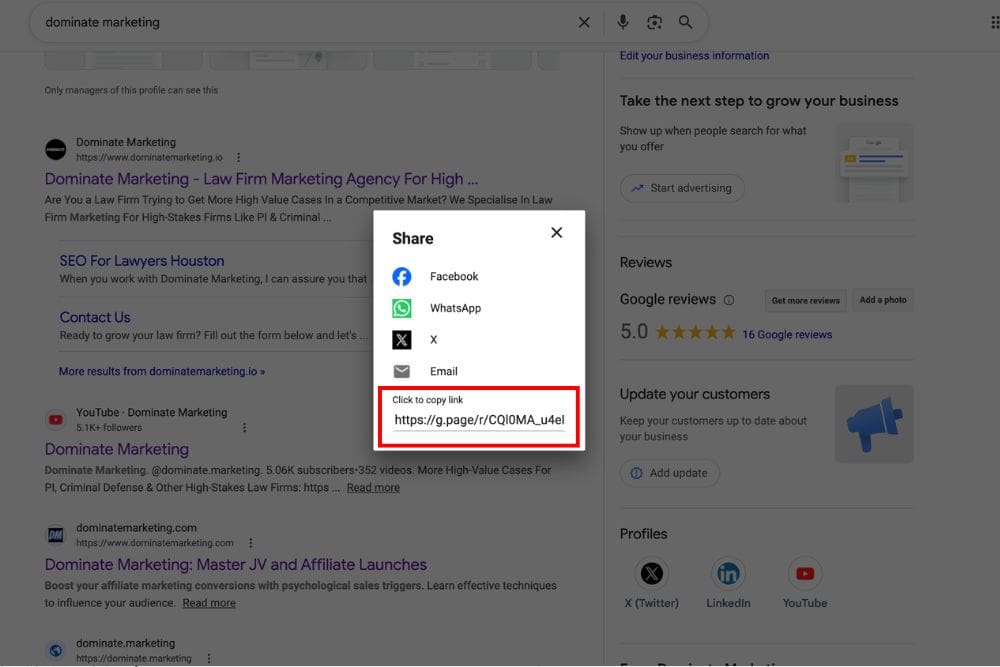
Send this link via text message immediately after the client confirms they’re willing to leave a review.
Text messages have significantly higher open rates than email, which means your review request is far more likely to be acted on when it arrives as a text.
If you’re sending the request via email instead, make the review link the most prominent element of the message.
Don’t bury it at the bottom of a long email.
A short message with a clear call to action and a direct link will always outperform a lengthy email that clients skim past.
What Role Does Review Content Play in Local Search Rankings?
The actual text within your Google reviews serves as indexed content on your Google Business Profile, which means the words your clients use in their reviews can influence what searches your firm appears for.
When a client writes a review mentioning that your firm helped them after a “car accident” or handled their “slip and fall case,” those terms become part of your profile’s content that Google factors into relevance.
These detailed reviews are worth significantly more for your rankings than generic one-line reviews like “great lawyer.”
The more specific the review content, the stronger the relevance signals it sends to Google about the types of cases your firm handles and the areas you serve.
Should You Provide a Review Template for Clients?
Many clients genuinely want to leave a review but don’t know what to write, which causes them to put it off indefinitely or write something generic that doesn’t help your rankings.
Providing a draft review that clients can copy, customize, and paste eliminates this friction entirely.
This is not the same thing as writing fake reviews or paying for reviews, both of which violate Google’s policies.
You’re giving clients a starting point that they’re free to edit, rewrite, or ignore entirely.
The goal is to remove the blank-page problem that stops many people from following through.
A good review template for a personal injury client might look something like this:
“I hired [Firm Name] after my [type of accident]. From the first consultation, they were [positive attribute like responsive, professional, compassionate]. They handled everything and kept me informed throughout the process. I’m very happy with the result and would recommend them to anyone dealing with a personal injury case in [city/region].”
When you send this template to a client, make it clear that it’s just a suggestion.
Tell them: “Here’s a rough draft based on your experience. Feel free to change anything, add your own details, or write something completely different. Whatever feels authentic to you.”
Most clients will modify the template to match their own voice and add personal details, which results in a unique review that reflects their genuine experience.
The key is that you removed the friction of starting from scratch.
Instead of staring at a blank review box and closing the tab, they now have a starting point that takes 30 seconds to customize and submit.
What Does an Effective Review Request Workflow Look Like?
A structured review request workflow ensures that no client falls through the cracks and that your firm is consistently generating new reviews every month.
Here’s the process that works best for personal injury firms.
Step one happens at the moment of case resolution.
The attorney or case manager calls the client to share the good news about their settlement or verdict.
During this call, they briefly mention that a Google review would be appreciated and let the client know they’ll receive a link shortly.
Step two happens within 24 hours of that call.
A staff member sends the client a text message or email containing your Google review link and the optional review template.
The message should be warm, brief, and personal.
Step three is a follow-up reminder sent three to five days later if the client hasn’t left a review yet.
This is a gentle nudge, not a demand.
Something like: “Hi [Name], just wanted to follow up on the review link we sent. No pressure at all, but if you have a couple of minutes, we’d really appreciate it.”
Step four is responding to every review within 24-48 hours of it being posted.
Thank the client publicly, reference something specific about their case or experience (without sharing confidential details), and keep the response professional and genuine.
This four-step process creates a consistent pipeline of new reviews that maintains your review velocity and keeps your Google Business Profile active and competitive.
Why Does Responding to Reviews Impact Your Rankings?
Responding to Google reviews is one of the most underutilized ranking strategies for personal injury law firms.
Every response you write creates new text content on your Google Business Profile, which Google indexes and uses for relevance analysis.
It also signals to Google that your business is active and engaged, which contributes to your prominence score.
According to BrightLocal’s 2026 survey, 81% of consumers expect to hear back from a business within a week of posting a review, and 32% expect a response by the following day.
Failing to respond to reviews doesn’t just hurt your reputation with potential clients.
It sends a negative engagement signal to Google’s algorithm, suggesting your firm isn’t actively managing its online presence.
When you respond to reviews, you have an opportunity to naturally include relevant terms.
For example, if a client writes “great experience,” your response could say something like “Thank you for trusting our personal injury team in [city name] with your case. We’re glad we could help you through the process.”
This response naturally includes your practice area, location, and relevant context without stuffing keywords.
It creates additional indexed content that strengthens your profile’s relevance for local personal injury searches.
Responding to negative reviews is equally important.
A thoughtful, professional response to criticism shows both Google and potential clients that your firm takes feedback seriously.
Prospective clients reading your reviews will often pay more attention to how you handle negative feedback than they do to the positive reviews themselves.
How Should Personal Injury Firms Handle Negative Google Reviews?
Negative reviews are inevitable for any business, including personal injury law firms.
The way you handle them can either damage your firm’s reputation or actually strengthen it.
The first rule is to never ignore a negative review.
Respond promptly, professionally, and empathetically.
Acknowledge the client’s frustration without getting defensive or disclosing any confidential case details, while addressing what happened and why.
Never argue with a reviewer publicly, even if their claims are inaccurate.
Potential clients reading the exchange will judge your firm based on how you handle the situation, not on who is right or wrong in the dispute.
Use this as an opportunity to speak to potential new clients, possibly even winning them over based on how you respond.
If a review violates Google’s content policies (for example, if it’s from someone who was never a client), you can flag it for removal through your Google Business Profile.
However, legitimate negative reviews, even unfair-sounding ones, generally won’t be removed by Google, so a professional response is your best course of action.
What Are Common Mistakes Personal Injury Firms Make with Their Review Strategy?
The biggest mistake most personal injury firms make is not having a review strategy at all.
They rely on clients to leave reviews on their own, which results in a trickle of reviews that doesn’t move the needle on rankings.
According to BrightLocal’s research, as much as 70% of reviews come from post-transactional review request emails, which means firms that don’t actively ask for reviews are leaving the vast majority of potential reviews on the table.
Another common mistake is asking for reviews in bursts instead of consistently.
Some firms will run a “review campaign” once or twice a year, generating a spike of 10-15 reviews in a single week and then going quiet for months.
Google’s algorithm is sophisticated enough to recognize unnatural patterns, and a steady flow of reviews is always preferable to sporadic bursts.
Failing to respond to reviews is another significant error.
When potential clients see a firm with dozens of reviews and no responses from the firm itself, it creates an impression of indifference.
It also wastes the ranking opportunity that each review response provides.
Ignoring negative reviews is perhaps the most damaging mistake of all.
A single unanswered negative review can outweigh multiple positive ones in the eyes of a potential client because it suggests the firm doesn’t care about client satisfaction or isn’t willing to address criticism.
Finally, many firms make the mistake of focusing only on their star rating and ignoring review volume, velocity, and content.
A 5.0-star rating with six reviews will lose out to a 4.6-star rating with 150 reviews in both Google’s algorithm and the trust perceptions of potential clients.
What Other Factors Should Personal Injury Firms Consider for Their Google Business Profile?
While reviews are one of the most impactful ranking factors you can control, they work best when combined with a fully optimized Google Business Profile.
Make sure every section of your profile is filled out completely, including your business description, services, hours, photos, and categories.
Select the most accurate primary category for your firm (typically “Personal injury attorney”) and add relevant secondary categories.
Post regular updates to your Google Business Profile, including photos of your team, your office, and any community involvement or events.
Active profiles with recent photos, posts, and reviews signal to Google that your firm is engaged and operating.
Ensure that your firm’s name, address, and phone number are consistent across your Google Business Profile, your website, and every online directory where your firm is listed.
Inconsistencies in this information can confuse Google’s algorithm and hurt your local rankings.
Your website should also reinforce the signals from your Google Business Profile.
Having location-specific service pages, strong on-page SEO, and a fast-loading, mobile-friendly design all contribute to the prominence signals that Google uses alongside reviews to determine your Map Pack position.
Need Help Building a Google Reviews Strategy That Actually Moves the Needle?
A strong Google reviews strategy is one of the fastest and most impactful ways for personal injury law firms to improve their local search rankings and attract more clients.
But reviews are just one piece of a comprehensive personal injury SEO strategy that includes on-page optimization, content, link building, technical SEO, and Google Business Profile management.
At Dominate Marketing, we specialize in SEO for personal injury law firms and can help you optimize your GBP, move up in the local results and ultimately, sign more high-value injury cases.
Contact us today by filling out the form below.
Frequently Asked Questions
How Do Google Reviews Affect Personal Injury Law Firm Rankings?
Google reviews directly affect local search rankings for personal injury firms through a factor Google calls “prominence.” Google’s own documentation confirms that review count and review score factor into local ranking. The Whitespark 2026 Local Search Ranking Factors survey found that review signals account for approximately 16-20% of local pack ranking factors, making them the second most influential factor behind proximity.
How Many Google Reviews Does a Personal Injury Firm Need to Be Competitive?
The number of reviews you need depends on your local market and what your competitors have. As a general benchmark, top-ranking local businesses average around 47 reviews according to research. In competitive personal injury markets, firms often need 100 or more reviews with consistent monthly additions of two to three new reviews to maintain strong Map Pack rankings.
What Is the Best Way to Ask Personal Injury Clients for Google Reviews?
The most effective approach is asking clients at the moment of case resolution when satisfaction is highest. Follow up within 24 hours with a text message or email containing your direct Google review link and an optional review template they can customize. A gentle follow-up reminder three to five days later helps capture clients who intended to leave a review but forgot.
How Often Should a Personal Injury Firm Get New Google Reviews?
Review velocity is a critical ranking signal, meaning Google values a consistent stream of new reviews over a large total with no recent activity. Aim for at least one to two new reviews per month as a minimum, though competitive markets may require more. Firms that stop receiving new reviews for extended periods will likely see their local rankings decline over time.
Does Responding to Google Reviews Help with Local SEO?
Responding to reviews creates fresh indexed content on your Google Business Profile, signals to Google that your business is active, and provides an opportunity to naturally include relevant terms like your practice area and location. BrightLocal’s 2026 survey found that 81% of consumers expect a review response within a week, so timely responses also build trust with potential clients researching your firm.
Can Negative Google Reviews Hurt a Personal Injury Firm’s Rankings?
A small number of negative reviews within a large base of positive reviews won’t significantly hurt rankings. What matters more is your overall star rating and how you respond to criticism. Firms that respond professionally and promptly to negative reviews demonstrate accountability, which strengthens trust with both potential clients and Google’s algorithm. The real risk comes from ignoring negative reviews entirely.